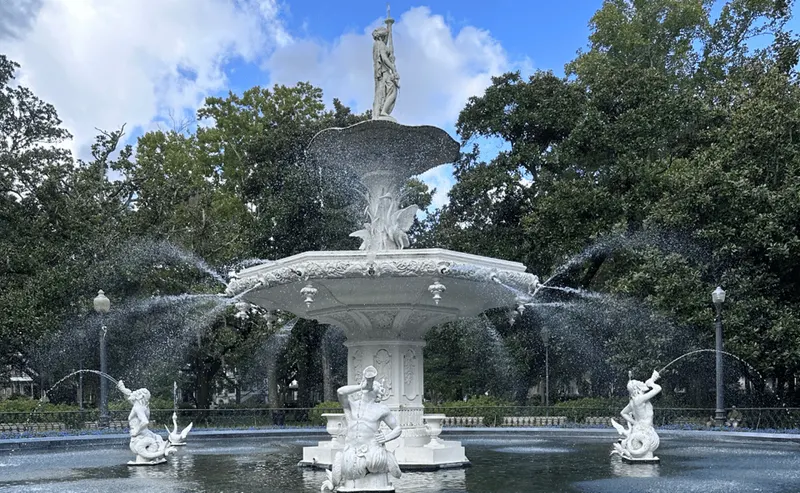
★ 5.0 (43)1.5 hoursfrom $35
History of Savannah Walking Tour
Check availability →Free cancellation listed
Walk one line of squares, add one house museum, and save the riverfront for its own loop.
Written by Alex H., Travel editor and researcherUpdated September 2026
Oglethorpe's 1733 plan put public squares at the center of each ward, and Savannah kept repeating it. Twenty-two squares survive in the district today. They are not little parks between the attractions; they are the operating system.
Bull Street crosses five of them in about a mile. That is enough for a first walk, especially once a museum, lunch and the brick sidewalks begin editing your timetable.
A square occupies the middle of each ward. House lots sit north and south; “trust” blocks for churches and public buildings sit east and west. The city grew by copying that unit until it had 24 squares. Elbert and Liberty were largely lost, while Ellis returned over an underground garage in 2010.
Bull Street runs straight down the middle of the district from Bay Street to Forsyth Park, and five squares sit on it. Walk it south and you see how the plan works, and each square gives you something to stop for.
| Square | What is there |
|---|---|
| Johnson Square | The 1830 obelisk to General Nathanael Greene, designed by William Strickland; Lafayette laid its cornerstone in 1825. |
| Wright Square | A granite boulder placed by the Colonial Dames for Tomochichi, the Yamacraw leader who welcomed the colonists and was buried here in 1739, and the 1883 monument to William Washington Gordon. The square took its present name around 1763. |
| Chippewa Square | Daniel Chester French's nine-foot bronze of James Oglethorpe, unveiled in 1910, facing south toward Spanish Florida. The Forrest Gump bench scene was filmed on the square's north side; the bench was a prop. |
| Madison Square | Laid out in 1837. The 1888 monument to Sergeant William Jasper by Alexander Doyle. |
| Monterey Square | The Pulaski Monument, cornerstone 1853, completed 1854. Forsyth Park is south along Bull Street. |
The line takes a morning with stops and leaves room for one museum or meal. Continue to Forsyth only if the group still wants the distance. On a hot or wet day, shorten the outdoor stretch and use Telfair for the middle.
| Area | Good fit for | Know first |
|---|---|---|
| River and north edge | River Street, Factors Walk, the 1887 Cotton Exchange on Bay Street, the free ferry and the riverboats | A steep drop between Bay and River streets; two public elevators avoid the steps |
| North and central squares | Johnson, Wright, Chippewa and Columbia squares; the Owens-Thomas and Davenport houses; Broughton Street; a first walk | A timed museum entry sets the order of the walk |
| South of Liberty Street | Calmer residential blocks, Madison and Monterey squares, Jones Street and the route to Forsyth Park | Forsyth lies beyond the district's Gwinnett Street boundary |
| West edge | City Market, Ellis and Franklin squares, the museums along Martin Luther King Jr. Boulevard | Weekend activity and event closures can slow vehicles |
For a hotel, north means river and nightlife; south means squares and a quieter walk home. The hotel guide adds the fees.
Owens-Thomas is my first choice because its guided visit includes both the William Jay house and the quarters of the people the household enslaved. Davenport explains how preservation saved much of the district. Andrew Low connects to Juliette Gordon Low. First African Baptist and the Cathedral add living religious history, but services take priority over visitors.
Owens-Thomas has the hard capacity limit, so reserve it and let the squares flex. The Prohibition Museum fills an unplanned indoor hour; Colonial Park fills a daytime detour east of Bull Street.
A guided walk gives depth. A trolley gives narration and coverage. The free DOT and ferry simply move you. Check CAT's current schedule around events.
Each answers a different need: depth on a subject, the option to hop off, or more ground in the same time.
Highlights & Hidden Gems Guided Walking Tour
★ 4.8 (255 reviews) · 2 hours · from $25
A guided walk through the central squares; the closest match to the Bull Street line above.
Old Town Hop-On Hop-Off Trolley Tour
★ 4.7 (1,872 reviews) · 1 day · from $46
Narration plus all-day reboarding at 16 operator stops when the group would rather not walk the whole grid.
See the catalog breakdownHistoric Downtown Savannah: Guided Segway Tour
★ 4.9 (299 reviews) · 1 - 1.5 hours · from $55
Covers more of the district than a walk in the same time; check the listed rider requirements.
See the catalog breakdownCatalog prices and ratings can move. Checkout shows the final terms. These links may earn the site a commission at no extra cost to you.
Leave the car in one garage. River Street sits below Bay Street; public elevators avoid the steps, though not the rough paving. The parking and river guides handle the details.
Choose a garage near the first or last stop. Driving square to square creates more trouble than it saves.
The DOT and ferry cost nothing and narrate nothing. Use them for tired feet and river views.
Book Owens-Thomas first and build the walk around it. The squares will still be there.
The Bull Street line is only about a mile, but crossings, heat and interesting detours make it feel longer.
Tours and visitor access yield to services, weddings and funerals. Confirm before walking over.
Descend once, walk one way and use a public elevator back up. The waterfront paving remains rough.
The National Register district runs from the river to Gwinnett Street and from East Broad to Martin Luther King Jr. Boulevard. Hotel listings may use the term more loosely.
Walk the squares, add one house museum, then visit River Street as a separate loop below the bluff. Tours, churches and Colonial Park fit around that.
North is closer to the river and museums; south is closer to the quieter squares and Forsyth. Choose by the walk home at night.
Oglethorpe's 1733 plan centered each ward on public space, and the city grew by repeating the pattern.
Twenty-two of the original 24. Elbert and Liberty were largely lost; Ellis returned over an underground garage in 2010.
The five-square Bull Street line takes a morning with stops. Add more time for a museum, meal or Forsyth Park.
The streets, squares, DOT shuttle and ferry are free. Museums, church tours, parking and commercial tours cost extra.
Owens-Thomas for the strongest first visit, Davenport for preservation history, or Andrew Low for Juliette Gordon Low.
In one city garage near the first or last stop. Leave the car there and walk or use the DOT.
The warehouse levels between Bay and River streets where cotton factors worked, joined to the bluff by walkways.
The old market gave way to a parking garage in 1954. That garage was later replaced underground, allowing the public square to return in 2010.
Yes, during posted visitor hours and outside services, weddings or funerals. A $3 adult donation is requested.
Start at Johnson Square, walk south through Wright, Chippewa and Madison, and finish at Monterey Square. Reserve the Owens-Thomas House for the early afternoon and leave the Davenport House for a second day. Extend to Forsyth only if the distance still suits the group; River Street is tomorrow's loop.
Bookable tours
A shorter history walk, a guided bike tour and the book-and-film themed walk cover the same grid with a different subject or pace. Check the route and meeting point in the listing.
Free cancellation listed
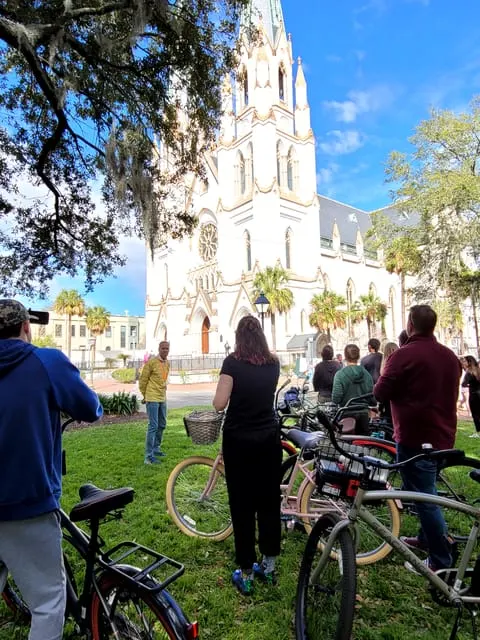
Free cancellation listed
Free cancellation listed
Checked September 1, 2026. Schedules, fees and policies can change, so recheck a linked source when the detail will affect your visit.
Give the squares a morning, a house museum an afternoon and River Street its own loop. The tour guide helps if you would rather hear the grid explained.
Disclosure: booking links go to GetYourGuide and may earn this site a commission at no extra cost to you. Commission never changes the rankings; see how Alex chooses.